Selling Solar Power with AI: Auto Mode for PV and Storage
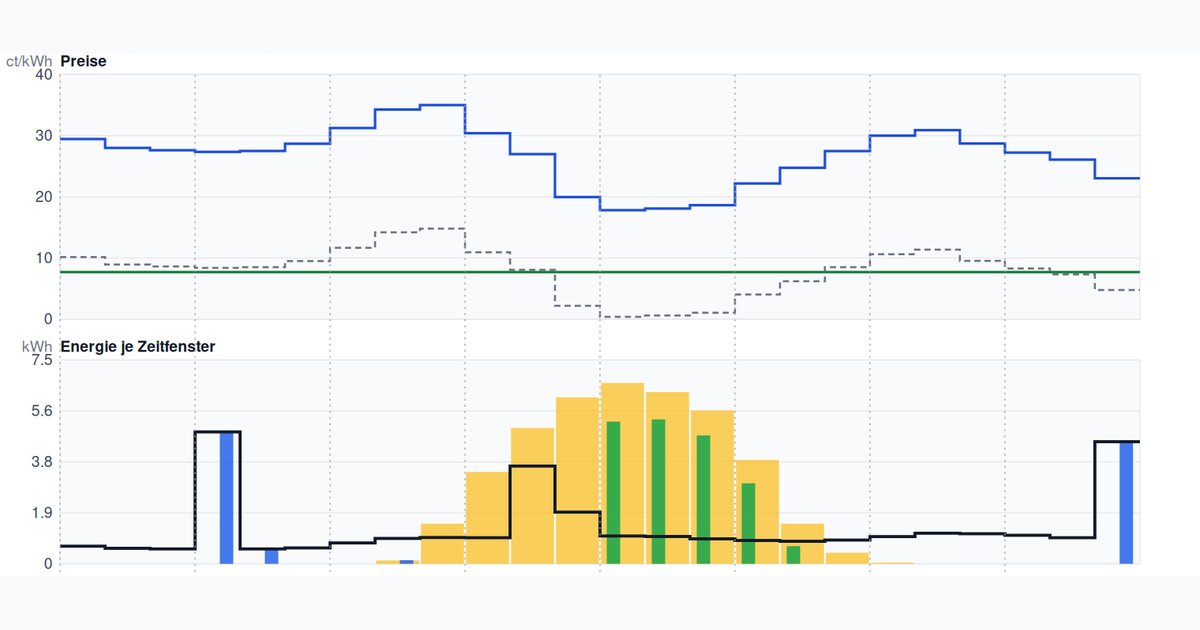
Selling solar power with AI does not mean an agent trades on the power exchange. The solar auto mode in the SMarTrAgents Cloud fetches day-ahead prices and the irradiance forecast, turns them into a schedule for battery, wallbox, heat pump and feed-in, and only controls what you have released through your own integration. Your power is still sold through your tariff, your grid operator or a direct marketer.
Since Germany’s solar peak law, new systems earn nothing in quarter-hours with a negative exchange price, and since 2025 every supplier has to offer a dynamic tariff. Anyone with PV and a battery faces that calculation every day. Using a real run from 9 October 2026, this article shows what the solar auto mode skill does in the SMarTrAgents Cloud and what it does not. As of 9 October 2026.
What is a solar auto mode?
A solar auto mode is an AI agent that runs a solar system like an energy manager: every day it fetches day-ahead prices and the irradiance forecast, calculates PV yield and household load, places wallbox and heat pump in the cheapest hours and optimises the battery schedule by dynamic programming over up to 36 hours. A chat that suggests “charge the battery at night” is not an auto mode; here a program does the maths, and every decision is in the report with numbers and a reason.
In the SMarTrAgents Cloud it is a skill, a fixed set of working instructions with a calculation program that your agents load as soon as the topic is a solar system, a battery or an electricity tariff; the difference to a chatbot is explained in What are AI agents. You decide how far it may go:
| Analysis | Recommendation | Auto mode | |
|---|---|---|---|
| What happens | record the system, evaluate yield and prices, compare tariffs and marketing routes | daily schedule for battery, wallbox, heat pump and feed-in | a routine fetches prices and forecast, calculates the schedule, sends commands through the released integration |
| What you get | system profile, tariff comparison, assessment with sources as PDF | report with action list, chart, key figures against the “no optimisation” reference | executed commands with log, daily and monthly report |
| Release level | 0, observe only | 1, recommend | 2 for battery and feed-in limit, 3 additionally for wallbox and heat pump |
Who actually sells the solar power?
A household does not trade on EPEX SPOT itself; market access belongs to suppliers, direct marketers and aggregators. When buying, your supplier passes the quarter-hour prices plus a margin through to you with a dynamic tariff under section 41a of the German Energy Industry Act (EnWG); when selling, the grid operator pays the fixed feed-in tariff, or a direct marketer sells your power and pays out the proceeds minus a fee. The agent therefore optimises schedules and prepares contract decisions with comparison tables; it signs no contracts and gives no financial, tax or legal advice.
A real day: Augsburg, 9 October 2026
The example profile: 9.8 kWp on a south-facing roof, 10 kWh battery, annual consumption 4,500 kWh from a standard load profile, a wallbox needing 8 kWh per day between 18:00 and 07:00, a heat pump needing 12 kWh per day, a dynamic tariff with example surcharges, a fixed feed-in tariff, a new system with a smart meter. All figures come from the calculation program’s run at 08:21, not from a language model.
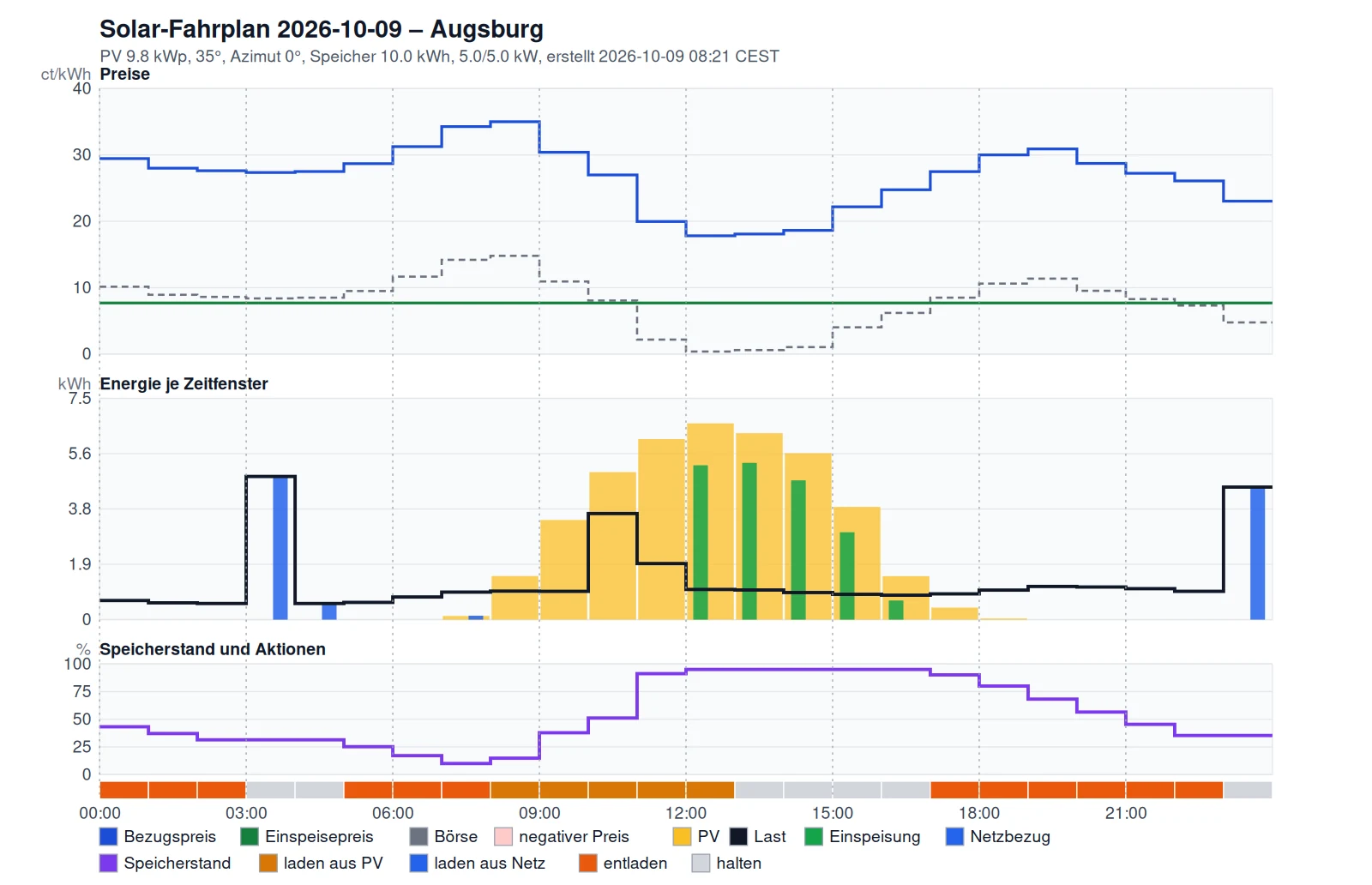
At night the battery covers the base load, at 3 o’clock the wallbox charges 4.3 kWh in the cheapest night hour, from 8 o’clock the surplus goes into the battery instead of the grid, the heat pump runs on surplus between 10 and 12 o’clock, from 17 o’clock the battery discharges into the evening peak. It does not charge from the grid, because the gap between night and evening price does not cover losses and cycle costs; the schedule records the decision with price and reason for every slot.
| Key figure of the day | Optimised | Battery self-consumption only | No battery |
|---|---|---|---|
| PV yield / consumption | 40.45 / 32.13 kWh | 40.45 / 32.13 kWh | 40.45 / 32.13 kWh |
| Grid import / feed-in | 10.03 / 18.87 kWh | 7.62 / 18.87 kWh | 19.50 / 27.82 kWh |
| Grid cost / feed-in revenue / cycle cost | €2.56 / €1.45 / €0.60 | €2.09 / €1.45 / €0.75 | €5.32 / €2.14 / €0 |
| Net | €1.70 | €1.39 | €3.18 |
| Self-sufficiency / full cycles / state of charge at the end | 68.8 % / 0.95 / 35.3 % | 76.3 % / 1.19 / 10.0 % | 39.3 % / 0 / 0 % |
| Saving against the reference, adjusted for the state of charge (residual value 16.19 ct/kWh) | +€0.10, cash effect within the day −€0.31 |
Read honestly: on a sunny October day with a fixed feed-in tariff and no negative prices, a battery that simply stores surplus and covers demand is already close to optimal. The optimised version even costs slightly more within the day, because it leaves the battery at 35 instead of 10 percent in the evening; valued at the grid import this remainder replaces at night, a small advantage remains. The added value comes on days with negative prices, with large price spreads in winter and through load shifting.
Feed-in at negative prices: 5 September 2026
Since 25 February 2025, section 51 of the Renewable Energy Act (EEG) reduces the applicable value to zero in periods with a negative spot price: new systems with a smart meter receive no payment for those quarter-hours, existing systems keep the old rule. According to trade press there were 573 such hours in 2025, and in September 2026 the skill counted 143 negative quarter-hours. As test data it ships 5 September 2026, a real day with 32 negative quarter-hours between 09:30 and 17:30: the schedule blocks feed-in in each of them, charges the surplus into the battery while there is room and curtails the rest; the reference without control keeps feeding in and gets nothing for it.
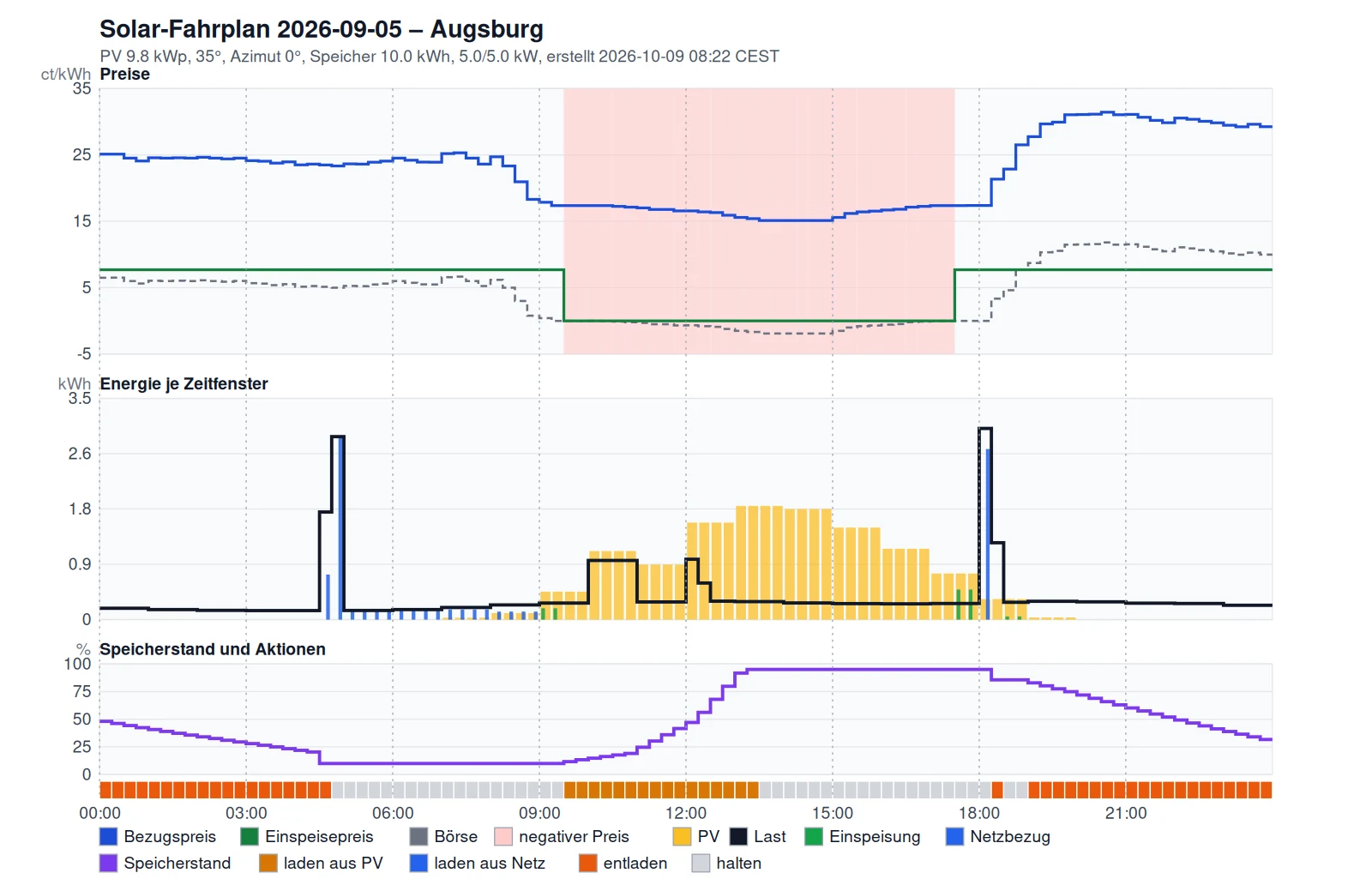
Figures of the run: PV yield 45.16 kWh, consumption 33.65 kWh, exchange price between −1.9 and 11.8 ct/kWh. Optimised: feed-in 1.41 kWh, blocked in negative slots 19.64 kWh, revenue €0.11, net €2.38. Reference without control: feed-in 20.95 kWh, revenue €0.07, net €2.28. Command list: 128 entries, 32 of them feed-in blocks.
With a fixed feed-in tariff the difference in revenue on such a day is close to zero; the benefit lies in following the rules. With direct marketing, feeding in at negative prices would cost money, and the block avoids that loss.
Dynamic electricity tariff with a battery: is it worth it?
Since 1 January 2025 all suppliers must offer dynamic tariffs under section 41a EnWG, a smart meter being the prerequisite; day-ahead prices have been traded in 96 quarter-hours per day since 1 October 2025 and are published around 13:00 for the following day. Whether it pays off, the skill calculates with a whole month of prices and weather, here for September 2026 with the example values of the profile:
| Scenario September 2026 | Feed-in | Revenue | Net per month | vs. A |
|---|---|---|---|---|
| A: fixed tariff, EEG feed-in tariff, battery on self-consumption | 652 kWh | €39.22 | €88.43 | ±0 |
| B: dynamic tariff, EEG feed-in tariff, battery on self-consumption | 653 kWh | €39.29 | €98.85 | +€10.42 |
| C: dynamic tariff, EEG feed-in tariff, battery optimised | 550 kWh | €42.31 | €93.41 | +€4.98 |
| D: dynamic tariff, direct marketing, battery optimised | 524 kWh | €58.83 | €81.91 | −€6.52 |
| E: fixed tariff, direct marketing, battery on self-consumption | 652 kWh | €39.90 | €92.75 | +€4.32 |
Reading: with these example values the dynamic tariff was more expensive than the fixed one in September because the exchange price was high on average; battery optimisation recovered around half of the disadvantage, and direct marketing paid off thanks to high exchange revenues. One month is no statement about a year, so for a decision the agent calculates at least one summer and one winter month with the fees from the direct marketer’s price sheet.
What Enpal, 1KOMMA5° and Tibber do differently
Similar energy managers come from companies that sell systems or supply electricity; the difference lies less in the maths than in the lock-in. Enpal.One+ buys cheaply according to the provider, sells surplus at the exchange price on the day-ahead and intraday markets, advertises “up to €2,000 remuneration p. a.” with a footnote and requires Enpal components and its own tariff. Heartbeat AI by 1KOMMA5° controls battery, heat pump and wallbox by exchange prices, since May 2024 also with checked third-party systems; “electricity from 0 cents” is based on a customer evaluation from May to August 2024. Tibber Smart Dynamic bills in quarter-hour steps at €5.99/month plus around 2.15 ct/kWh margin and, with Smart Battery, also charges third-party batteries at low prices. The solar auto mode brings no tariff, is vendor-neutral through Home Assistant or evcc and stores every decision with its reason in your container; with a closed energy manager it stays at analysis and recommendation.
How it works in the SMarTrAgents Cloud
- Describe the system. Location, capacity, orientation, commissioning date, metering, battery with price and guaranteed cycles, tariff with price sheet, feed-in, wallbox and heat pump. Whatever is missing, the agent asks in one follow-up question; whatever you do not know stays in the system profile as a marked assumption.
- Get the analysis. The agent checks the data sources, calculates the day and a monthly comparison, puts everything in context with the legal framework and sources and delivers a PDF “Solar analysis”.
- Calibrate the forecast. On at least three days it compares its yield forecast with the readings of your inverter and adjusts the performance ratio.
- Read the daily schedule. Report with action list, chart and key figures against the “no optimisation” reference, every action with time and reason.
- Release. You set the release level in writing and name the integration (Home Assistant through the Cloud’s smart home skill, evcc or a manufacturer interface read-only) and the device names; the agent sends a test command “hold” and checks that the limits are also set in the device.
- Let the auto mode run. A routine fetches prices and forecast every hour, recalculates and sets the commands for the next slots; an extra run at 13:15 picks up the next day’s prices. Daily report at 21:30, monthly report on the first of the month, both as PDF.
Each day then leaves fahrplan.json, bericht.md, diagramm.svg and kennzahlen.json in your container, from level 2 aktionen.json, plus protokoll.jsonl with every decision. How routines and calendar work together is shown in Calendar and mailbox for all plans; how to cap the token budget of a continuous operation is in AI cost control.
Limits and honesty
- No exchange trading, no contracts. The agent buys and sells nothing on EPEX; tariff, direct marketing or energy sharing you sign yourself. It promises no yield.
- Forecasts are forecasts. On 9 October 2026 the yield model, at 40.45 kWh, was around a factor of 2 above forecast.solar at 19.46 kWh for the same system; without readings it cannot be decided which weather model was closer. That is why calibration against the inverter is mandatory, and until then the script limits every release to the recommendation level. Schedules are planning, not billing.
- Weather data with a licence. The free Open-Meteo API is meant for non-commercial use, so the agent never calls it from the cloud. If a customer’s own Open-Meteo key is stored as a secret in the container, the agent uses the customer API; without a key the yield forecast runs through forecast.solar with twelve calls per hour, only for today and tomorrow, without temperature correction and with a calibration factor. Prices come from Energy-Charts by Fraunhofer ISE; both sources are CC BY 4.0 and named in every report.
- Control only with release and within limits. Commands go exclusively through the released integration. Battery limits, charge and discharge power, at most 1.5 full cycles per day, dimming windows and the 4.2 kilowatt limit under section 14a EnWG, the feed-in limit under section 9 EEG and the ban on discharging the battery into the grid apply in every run. If data is missing, the last plan stays active; after three failed runs the agent switches to self-consumption, pauses and tells you. During the build, the auto mode was tested as far as the command list, not against a real Home Assistant.
- The benefit depends on the profile. Anyone who uses almost everything themselves saves little with a dynamic tariff; grid charging costs cycles. Without readings the skill uses a standard load profile that can be off by roughly 15 percent. The EEG amendment 2027 is a draft, and the agent calls it that.
- Data protection. Your system profile lives in your own container, credentials live in the container secrets, never in the chat or in reports. Accounts, chats and files are stored on servers in the EU at Hetzner Online GmbH (ISO/IEC 27001, currently Helsinki); depending on the mode, the language models run at providers in the USA, and all subprocessors are listed in the privacy policy. More under AI agents and GDPR.
Sources and legal status
Laws read on 8 October 2026 at gesetze-im-internet.de: section 51 EEG, section 9 EEG, section 100 EEG, section 41a EnWG, section 14a EnWG. Feed-in tariffs from 1 August 2026 according to ADAC and Lexware with reference to the Bundesnetzagentur, EEG amendment 2027 according to inFranken, negative hours in 2025 according to reduco, quarter-hour trading according to ZfK, all retrieved on 8 October 2026. Data sources: Energy-Charts API, Open-Meteo, pricing and licence, forecast.solar, account models, retrieved on 8 October 2026 and used in the run on 9 October 2026.
Frequently asked questions
Does the agent trade my solar power on the exchange itself?
No. Market access belongs to suppliers, direct marketers and aggregators; your power is still sold through the feed-in tariff, a direct marketer or your supplier’s tariff. The agent works out when battery, wallbox, heat pump and feed-in should run and prepares contract decisions; you sign the contract.
Do I need a dynamic tariff and a smart meter?
For buying at the exchange price, yes: dynamic tariffs under section 41a EnWG require a smart meter, and without one the 60 percent cap under section 9 EEG applies to new systems with a feed-in tariff. With a fixed tariff the agent still uses surplus, load shifting and the feed-in rules.
What happens at negative electricity prices?
For new systems with a smart meter the payment drops to zero in those quarter-hours. The schedule blocks feed-in, charges the surplus into the battery and curtails the rest; on 5 September 2026 that was 32 quarter-hours. Existing systems keep their payment, so feed-in continues there.
Is it worth charging the battery from the grid at night?
Only if the price gap between the cheap and the expensive hour covers losses and cycle costs. The optimiser checks that for every slot; on 9 October 2026 it therefore did not charge from the grid at all, while in winter, with large spreads, the calculation more often comes out differently.
How accurate is the yield forecast?
Only as accurate as the weather model and your system’s parameters. In the test the model deviated from forecast.solar by around a factor of 2; that is why the agent compares its forecast with your inverter’s readings on at least three days and adjusts the performance ratio. Until then it only recommends.
How do I start the solar auto mode in the SMarTrAgents Cloud?
You create a project for your system in the SMarTrAgents Cloud, describe it in the chat and first receive the analysis, then the daily recommendations; you give the release for control later in writing. What an account costs is on the pricing page; the trial access runs for seven days without payment details.
AI agent pricing
All plans, minute contingents and add-ons with final prices and a market comparison, on one page.