Autonomous AI agents for trades: what they do today
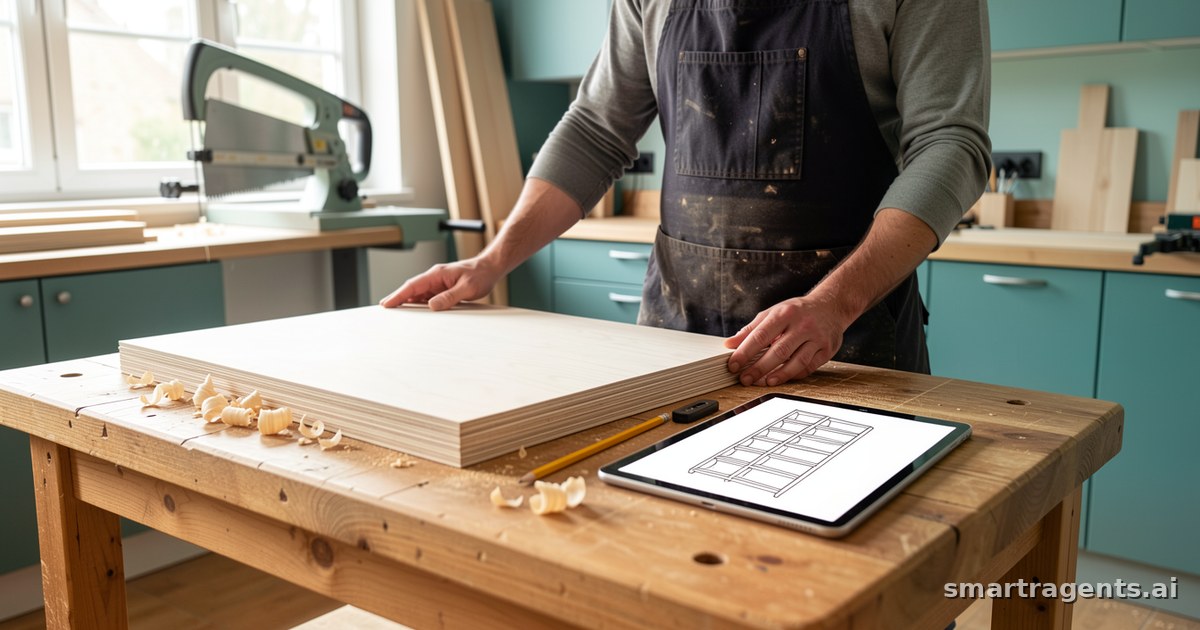
Autonomous AI agents for trade businesses are programs that handle office work for your business on their own, all the way to a finished result: they answer calls and book appointments within your time slots, write quotes from your dictation, follow up on open quotes and, in a joinery, calculate the cutting list and panel layout of a bookshelf. At SMarTrAgents, nine specialist agents plan their own steps, use tools and calculation programs, and put every result into your approval list. What leaves your business is your decision.
The day belongs to the job site, the office waits until evening: quotes, callbacks, follow-ups, material lists. That is exactly where autonomous AI agents come in. To many master craftsmen, “autonomous” sounds like losing control, like software that sends emails on its own. This article shows what autonomous AI agents really do for trade businesses today, where their independence ends and, with a real calculation run from a joinery, how an agent plans a bookshelf with cutting list, panel layout and exploded view. It is written for trade businesses, joiners, cabinetmakers, interior fitters and every master craftsman who no longer wants to sit at the desk in the evening.
What are autonomous AI agents?
An AI agent is a program with a language model as its head that receives a goal and plans the way there by itself. It decides which step to take next, uses tools such as calendar, inbox, files and calculation programs, checks the intermediate result and stops when the task is done. “Autonomous” means: you set the goal, not every single move. A chatbot answers a question; an AI agent completes a job. The basics are explained in What are AI agents.
| Chatbot | Fixed workflow | Autonomous AI agent | |
|---|---|---|---|
| Who plans the steps? | nobody, one answer per question | you, once during setup | the agent, anew for every job |
| Tools | none | the built-in ones | calendar, inbox, files, calculation programs, web search |
| Result | a text in the chat | always the same chain | draft, appointment, ticket, plan or document |
| The unexpected | gets ignored | breaks the chain | a question back or a different route |
| Control | you read along | you check the end | approval before anything is sent |
How autonomous may an AI agent be in a trade business?
As autonomous as you decide. In the SMarTrAgents Cloud there are three levels for this, and every task belongs to exactly one:
- Prepare, entirely alone: the agent researches, calculates and writes for as long as it takes. Draft quote, follow-up email, cutting list and decision paper come into being without your involvement.
- Act within your limits: on the phone, the phone assistant Ava books appointments, but only within the time slots you set for each weekday. She only sees when your calendar is busy, not what is in it.
- Approve, only by you: every email, every quote and every post waits in your approval list. Without your click, none of it goes out.
This is not a brake, it is the reason the division of labour works. Our guiding principle: Human with machine beats both human and machine. The agent brings stamina and calculation accuracy, you bring experience, knowledge of your customers and the signature.
Which tasks do AI agents take on in trade businesses today?
| Task | What the agent does on its own | What stays with you |
|---|---|---|
| A call while you are on site | Ava answers, understands the request, notes the callback number, creates a ticket with transcript and, if asked, books an appointment within your time slots | callback and decision |
| Quote after measuring | SMarTrContent writes the draft from your dictation with material, installation, travel, final price and payment terms, using the prices from your list | check, change, approve |
| Open quotes | SMarTrContent drafts the follow-up email with reference to quote and date | approve |
| Hourly rate and post-calculation | SMarTrTrader includes set-up and travel times and shows what is left | pricing decision |
| Larger purchase | SMarTrCeo compares buying, leasing and waiting in a decision paper | decide |
| Job site photos | SMarTrSocialMedia turns three photos and two sentences into posts for your channels | approve |
| Open position | SMarTrHRGott asks about the real working day and writes the job ad | approve |
| Cabinet, shelf, chest of drawers | the cabinet planner calculates cutting list, panel layout, shopping list and working time and draws the piece | check before cutting |
How the phone part works in detail is described in AI phone agent with a German phone number.
Joinery example: how does an AI agent plan a bookshelf?
Autonomy shows most clearly where calculation happens. The job in the chat reads: bookshelf, 1200 mm wide, 2000 mm high, 350 mm deep, four shelves per compartment, edges all round. For this, the agent loads the cabinet planner skill by itself, a fixed working instruction with a calculation program, writes the job as a file and starts the calculation. Whatever is missing it fills with default values and lists them as assumptions: panel 19 mm, back panel 8 mm HDF set in a groove, saw kerf 4 mm, sheet size 2800 × 2070 mm. All figures in this section come from the calculation program, not from the language model.
First run: the agent warns about sagging
Without a divider, the shelves between the sides would be 1162 mm wide. The planner reports: “Compartment width 1162 mm > 900 mm: shelves made of 19 mm panel will sag.” Together with it comes the suggestion “divider against sagging”, with its effect: five more parts, 0.6 m² more material, almost one hour more work. This is what autonomous work looks like: the agent finds the problem itself, calculates the solution and puts both in front of you.
Second run: with divider, without warning
With a divider in the middle, the planner recalculates. The calculation path appears in the report with the numbers filled in:
- Inner width = width minus two panel thicknesses = 1200 − 2 × 19 = 1162 mm
- Inner height = 2000 − 2 × 19 = 1962 mm
- Compartment width = (inner width minus divider) divided by two compartments = (1162 − 19) / 2 = 571.5 mm
- Shelf = compartment width minus 2 mm clearance = 569.5 mm, depth 350 − 20 for the back panel groove = 330 mm
- Back panel in groove = (1162 + 20) × (1962 + 20) = 1182 × 1982 mm
| Pos. | Part | Qty | Length × width × thickness in mm |
|---|---|---|---|
| 1 | Side | 2 | 2000 × 350 × 19 |
| 2 | Bottom | 1 | 1162 × 350 × 19 |
| 3 | Top | 1 | 1162 × 350 × 19 |
| 4 | Divider | 1 | 1962 × 330 × 19 |
| 5 | Shelf | 8 | 569.5 × 330 × 19 |
| 6 | Back panel | 1 | 1182 × 1982 × 8 |
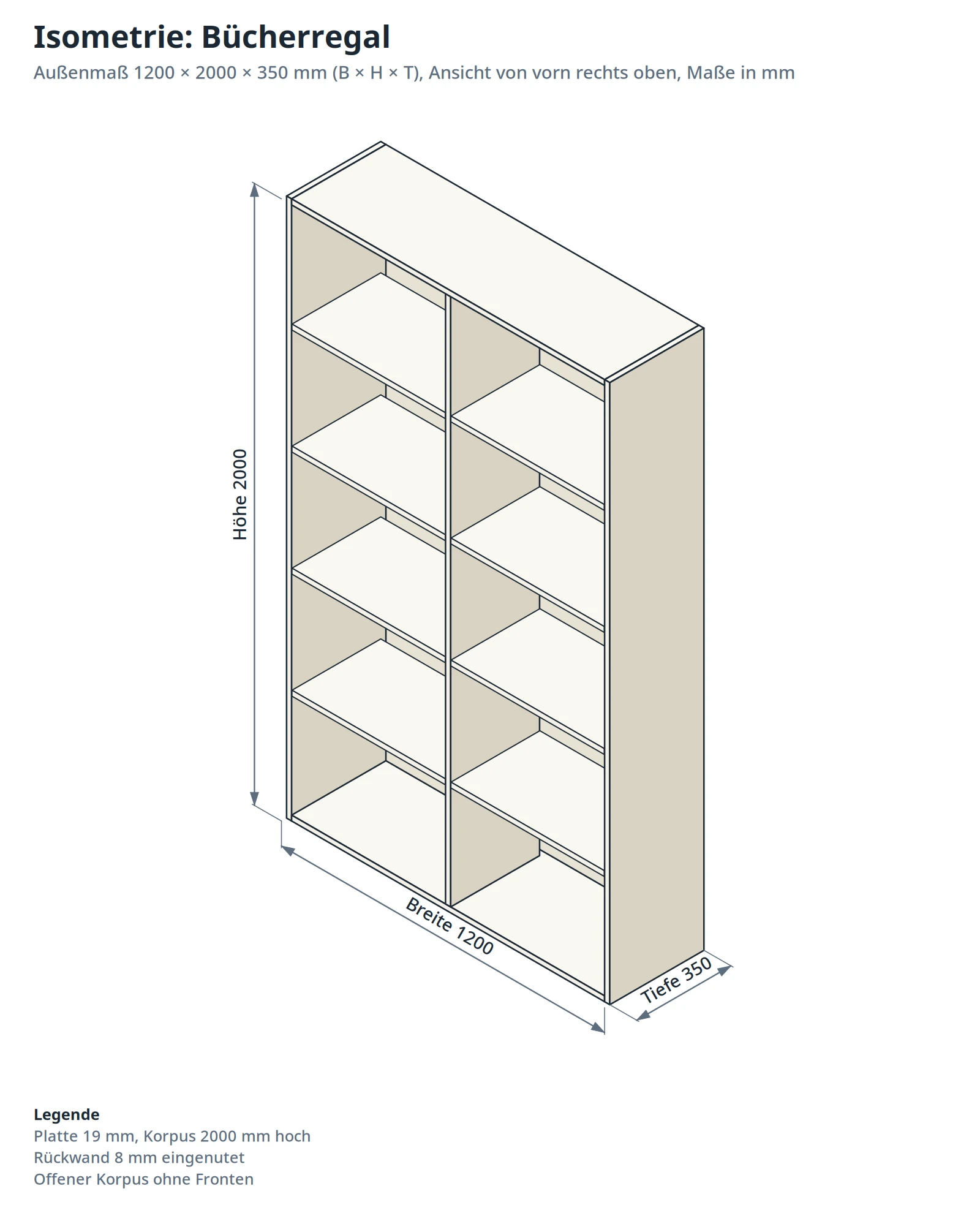
All 13 carcass parts fit on one chipboard sheet 2800 × 2070 mm, with a yield of 75.3 percent and 1.4 m² of offcut. The back panel gets its own HDF sheet. The shopping list also shows 36.2 m of edge banding including five percent allowance, 32 shelf supports, twelve wooden dowels and twelve cabinet connectors. Working time based on the default allowances for cutting, edging and assembly comes to just under four hours; you overwrite every allowance with the values of your workshop.
There are no euros in this run, because the job named no prices. The shopping list then shows “please add price”, and the agent invents neither panel price nor hourly rate. Prices only come from your list or from a dealer you name, with address and retrieval date in the document.
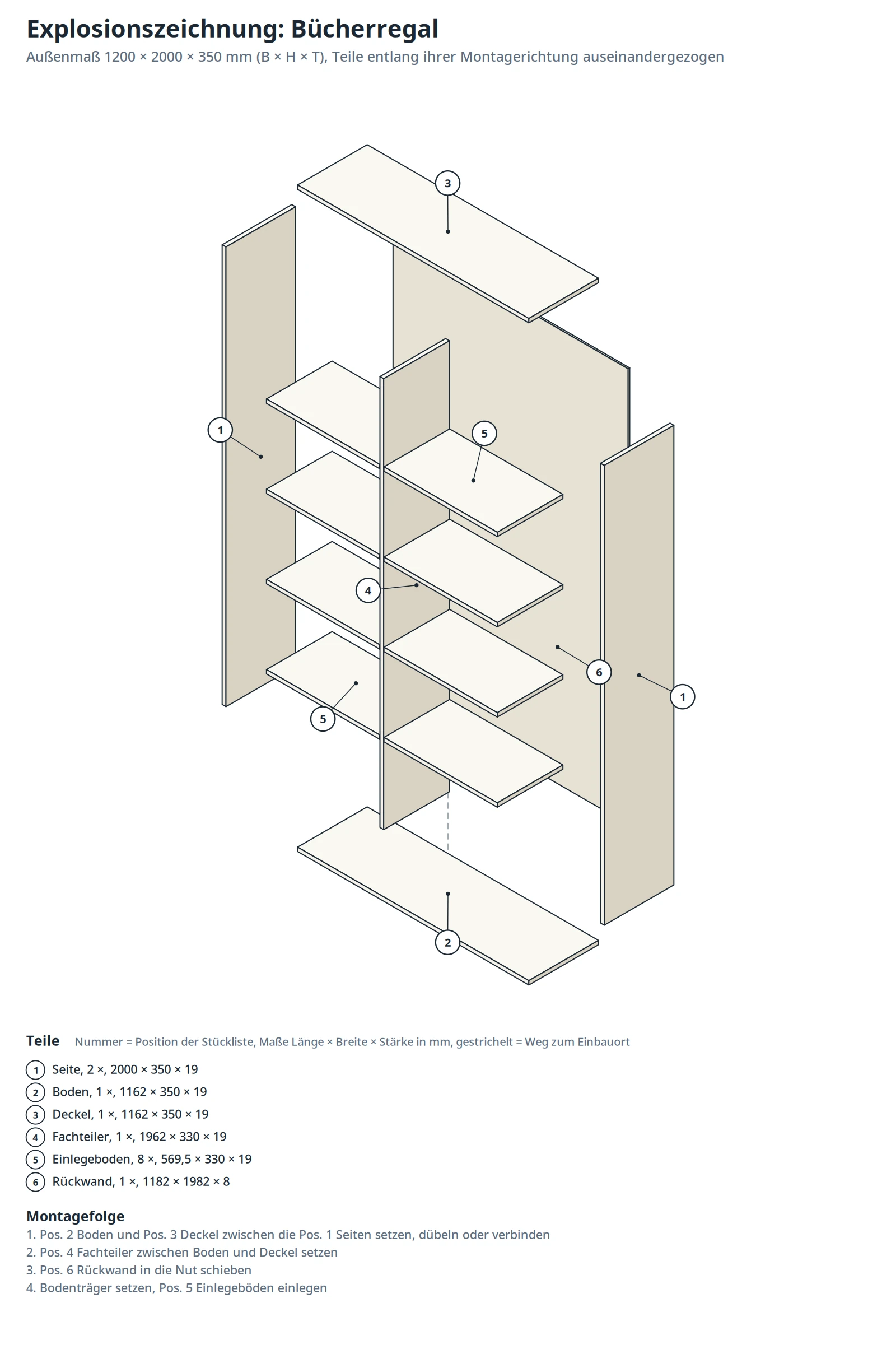
Finally, the agent builds the customer document as a PDF with drawings, cutting list, panel layout, shopping list and all assumptions, and suggests variants with their effect, such as a plinth against kicks or one more shelf per compartment. How the planner works through a kitchen base cabinet with doors and a cost block is shown in the article AI furniture planner.
What does the plan checker verify for free constructions?
Not everything in the workshop is a carcass. For frames, stands, substructures and built-in machines, the agent describes every part as a block in its real position, and a fixed drawing pipeline turns that into isometric views, elevations with dimension chains and one image per assembly step. Before a PDF is created, the plan checker runs over model and document. Among other things it checks:
- Cross-section: every timber has the cross-section you buy; a 40 × 60 leg is not 40 × 40 in the model.
- Support: no rail ends in mid-air, every horizontal panel rests on something, no post hangs without a connection.
- Overlaps: two parts never occupy the same space, unless a machine sits in a panel cut-out on purpose.
- Screws: every screw bites and does not break through. Example: 5 × 40 from above through a 19 mm panel into the rail gives 21 mm of thread engagement; required are at least 10 mm and three times the diameter.
- Document: the image under “Step 3” really shows step 3, and every material in the plan is on the shopping list.
Only when the checker reports green does the agent build the PDF. What it can safely repair in the text, it repairs itself; everything else the agent corrects in the model and checks again.
What stays with the master craftsman?
Autonomous AI agents take work off your hands, not responsibility. With you remain:
- Measuring on site. The agent calculates with your dimensions; whatever it has not measured, it lists as an assumption.
- The prices. Only your list or a source you approve. If a price is missing, the cell stays empty.
- Structural safety. The planner warns based on rules of thumb, for example about sagging, height and depth; that does not replace a structural calculation.
- The approval. Everything sent to customers, suppliers or applicants waits for your click.
- The signature. The quote to your customer is issued by you, not by the agent.
We are building specialist knowledge for further trades in the same way: fixed working instruction, calculation program, check before the result.
Where is the business data stored?
Accounts, chats and files of the SMarTrAgents Cloud are stored on servers in the EU at Hetzner Online GmbH, currently in Helsinki, Finland. Every business works in its own container; a data processing agreement is available on request. Depending on the selected mode, the language models also run at providers outside the EU; the calculation program of the cabinet planner runs in your container. Give the agents what they need for the task: price list, old quotes, measurements. Details are in AI agents and GDPR.
How do I get started with AI agents in my trade business?
- Create a trial account: the trial access runs for seven days with all nine agents and without payment details.
- Set up your business: create a project for your workshop and upload your price list and two old quotes.
- Dictate the first job: a quote after your last measurement or, in a joinery, the next cabinet with its dimensions.
- Add the phone: with SMarTrPhone, Ava answers calls while you are on site.
What the plans cost is on AI agent pricing.
Frequently asked questions
What are autonomous AI agents for trade businesses?
Programs with a language model that complete tasks for a trade business on their own: answering calls and booking appointments, drafting quotes, following up on open quotes, planning furniture with cutting list and panel layout. They plan their own steps and use tools; what leaves the business is approved by the master craftsman.
Does an AI agent send quotes without my approval?
No. Quotes, emails and posts land as drafts in your approval list and only go out after your click. Only Ava acts on her own on the phone, and only within the limits you set: appointments within your time slots, tickets in your list.
Do I need separate trade software for an AI agent?
No. The agents work in the browser at cloud.smartragents.ai, also on your phone in the workshop. You receive results such as quotes, cutting lists and plans as files, for example as PDF, and take them into your usual processes.
What data may I give an AI agent?
The data it needs for the task: price list, measurements, old quotes, your tone. As everywhere, customer data falls under the GDPR; the files are stored on servers in the EU, each business in its own container, and a data processing agreement is available on request.
Can the agent plan cabinets and shelves for my joinery?
Yes. The cabinet planner calculates rectangular carcass furniture made of panel material: cabinets, shelves, chests of drawers, sideboards. It delivers cutting list, panel layout with yield, shopping list, working time, drawings including an exploded view, and variants. Frames and stands are drawn from a parts list and checked before the PDF.
Do AI agents replace tradespeople?
No. They take over the office around the work: phone, quotes, follow-ups, planning. The craft itself, the measuring and the decision stay with people. Exactly this division of labour makes the business faster.
This article was written by our AI agents on behalf of the owner and reviewed by a human before publication.
Nine AI agents, one workspace
The agents draft quotes, keep the calendar and sort the inbox, and nothing goes out before you approve it.